
 by
by Back in the early days of electrical power, laboratory employees couldmeasure electric currentIn a circuit equipped with an ammeter (galvanometer) and a voltmeter, they were able to determine the resistance.
In 1920, British postal engineer Donald Macadie created the AVOmeter, a device capable of measuring three electrical properties (A = amps, V = volts, O = ohms). Shortly thereafter,electriciansworking in the field obtained somewhat portable versions of this invention.
Modern multimeters perform the same tasks as the AVOmeter, but they are more advanced and offer additional testing capabilities. Depending on the specific model, a multimeter can check if a diode or capacitor is functioning properly, identify whether the current is alternating or direct, and measure the temperature of a wire. The various functions are indicated by symbols located around a dial.
Homeowners doing DIY electrical workNo need for the same features as electronics technicians, so multimeters available at hardware stores are simpler than those found at electronics supply stores. Still, the symbols can be challenging to understand. Here's a summary of theelectrical termsand the symbols you'll encounter on a standard multimeter for household use and their meanings.
Essential Multimeter Symbols to Recognize
Voltage

Multimeters can measuredirect current (DC) and alternating current (AC) voltage, meaning they must show more than one voltage symbol. On certain older models, the label for AC voltage isVAC.Nowadays, it's more typical for manufacturers to add a wavy line above the V to represent AC voltage.
To indicate DC voltage, the standard is to draw a dashed line with a solid line above it over the letter V. To obtain voltage measurements in millivolts (one-thousandth of a volt), adjust the dial to mV.
- "V" with a tilde over it = AC voltage.
- “V” with one dot and one solid line above it = DC voltage.
- "mV" with one wavy line or a pair of lines, one dotted and one solid, above it= AC or DC millivolts.
Current
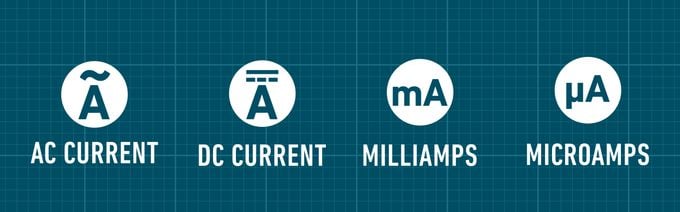
Similar to voltage, current can also be alternating or direct. Since the unit of current is amperes, oramps, the symbol for it is A.
- "Å" with a wavy line over it = AC current.
- "A" with two lines, one dashed and one solid, above it = DC current.
- mA = Milliamps.
- µA (µ is the Greek letter mu) = Microamperes (millionths of an ampere).
Resistance
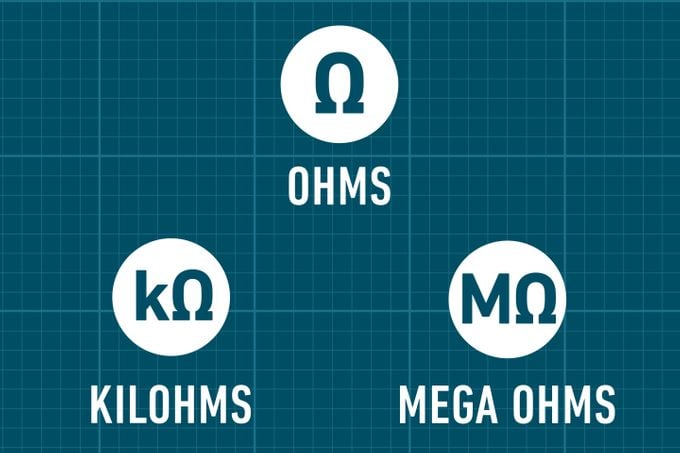
A multimeter determines resistance by transmitting a minor currentelectric currentvia the circuit. The symbol representing the unit of resistance, the ohm, is the Greek letter omega (Ω). Meters do not differentiate between AC and DC resistance, hence there are no lines above this symbol.
On devices that offer range selection, you can choose the kilohm (1,000 ohms) scale and the megohm (one million ohms) scale, denoted as kΩ and MΩ, respectively.
- Ω = Ohms.
- kΩ = Kilohms.
- MΩ = Mega ohms.
Continuity
Use a multimeterTo check for a break in an electrical circuit. The meter measures resistance, and there are just two possible results. Either the circuit is open, resulting in the meter showing infinite resistance, or the circuit is closed, causing the meter to display 0 (or nearly zero).
Since there are only two options, certain meters emit a beep when they sense a connection. This feature is indicated on the dial settings with a set of left-pointing brackets that grow larger, resembling a horizontal version of the wireless signal icon on a laptop.
Diode and Capacitance Tests

Electronic service technicians tend to utilize diode and capacitance testing more frequently than electricians or homeowners. However, if your multimeter includes these features, it's beneficial to understand what the symbols represent.
The diode test functionappears like an arrow directed towards the center of a plus sign. When this function is chosen, the meter will indicate if a diode (a typical electronic component that converts AC current to DC current) is functioning properly.
The capacitance functionresembles a right-facing bracket positioned to the right of a vertical line. Both elements are intersected by a horizontal line. Capacitors areelectronic devicesThat shop charges, and the meter can measure the charge.
The temperaturefunction measures the heat level of thecircuit wires. It is indicated by a thermometer.
Jacks and Buttons

Each multimeter comes with two leads, one black and one red. Some models feature three jacks while others have four. The specific jack you use for the leads depends on the type of measurement you are performing.
- COMThis is the common jack, and it's the only black one. You should always connect the black lead to this jack.
- AIs the jack the place where the red cable connects when measuring high current up to 10 amps?
- mAVΩIs the jack used for all other measurements, including precise current readings, voltage, resistance, and temperature, if the meter has just three jacks?
- mAµAIs the jack used for sensitive current measurements (less than one amp) if the meter has four jacks?
- VΩIs the jack used for all other measurements except current?
At the top of the meter display, above the dial, there are typically two buttons, one located on the left and the other on the right.
- Shift.To conserve space, producers might allocate two tasks to certain dial settings. You can activate the function highlighted in yellow by pressing the shift button, which is typically also yellow and could be labeled or not.
- Hold.Clicking this button saves the current reading for future use.
Manual vs. Auto Range
An older analog multimeter that uses a needle must have multiple range settings. If the meter only had a high range, it wouldn't be suitable for precise measurements since the needle would barely move. Conversely, if the meter only had a low range, any measurement that went beyond that limit, regardless of the value, would cause the needle to swing to its maximum.
Digital multimeters with LEDDisplays became available in the 1970s, and now most multimeters are digital. A few still feature range settings that you choose using a dial. However, more and more meters automatically select the range.
Since these multimeters lack range settings (which can take up to 18 dial positions), auto-range models can offer greater functionality compared to those with manual range adjustments.
Note: Keep the owner's manual of your multimeter for future reference. Store the manual along with the multimeter in a clean and dry condition inside a quart or gallon-sized plastic zip-lock storage bag.
No comments:
Post a Comment