
 by
by Even though shipping is the most environmentally efficient way to transport goods per tonne-kilometre, the massive scale of worldwide trade leads to a considerable ecological effect.
To achieve significant reductions in emissions – the industry currently accounts for about 3% of annual global CO2emissions – collaborative efforts are necessary throughout the supply chain.
Shipbuilders, engine makers, fuel suppliers, port officials, and shipping firms need to cooperate in order to speed up advancements and cut down on pollution.

Utilizing solar power on the ocean
Although it is a challenging industry to decarbonize, the shipping sector is experiencing a faster uptake of environmentally friendly technologies. Solar energy is becoming a highly appealing choice for incorporation into onboard electrical systems because of its availability, dependability, and emission-free nature.
Although once seen as challenging to implement in marine settings, ongoing progress in materials science and engineering is resulting in stronger, more efficient, and less expensive solar technologies tailored for use at sea.
For instance, advances in photovoltaic technology have led to the creation of light, adaptable, and rust-proof solar panels, enhancing the practicality of installing solar systems on commercial and passenger ships.
At the same time, advancements in storage and energy management systems are allowing vessels to store and utilize solar power more effectively, decreasing reliance on traditional fuels.
Onboard power generation and storage systems
Grafmarine has created a new method for producing and storing renewable energy.
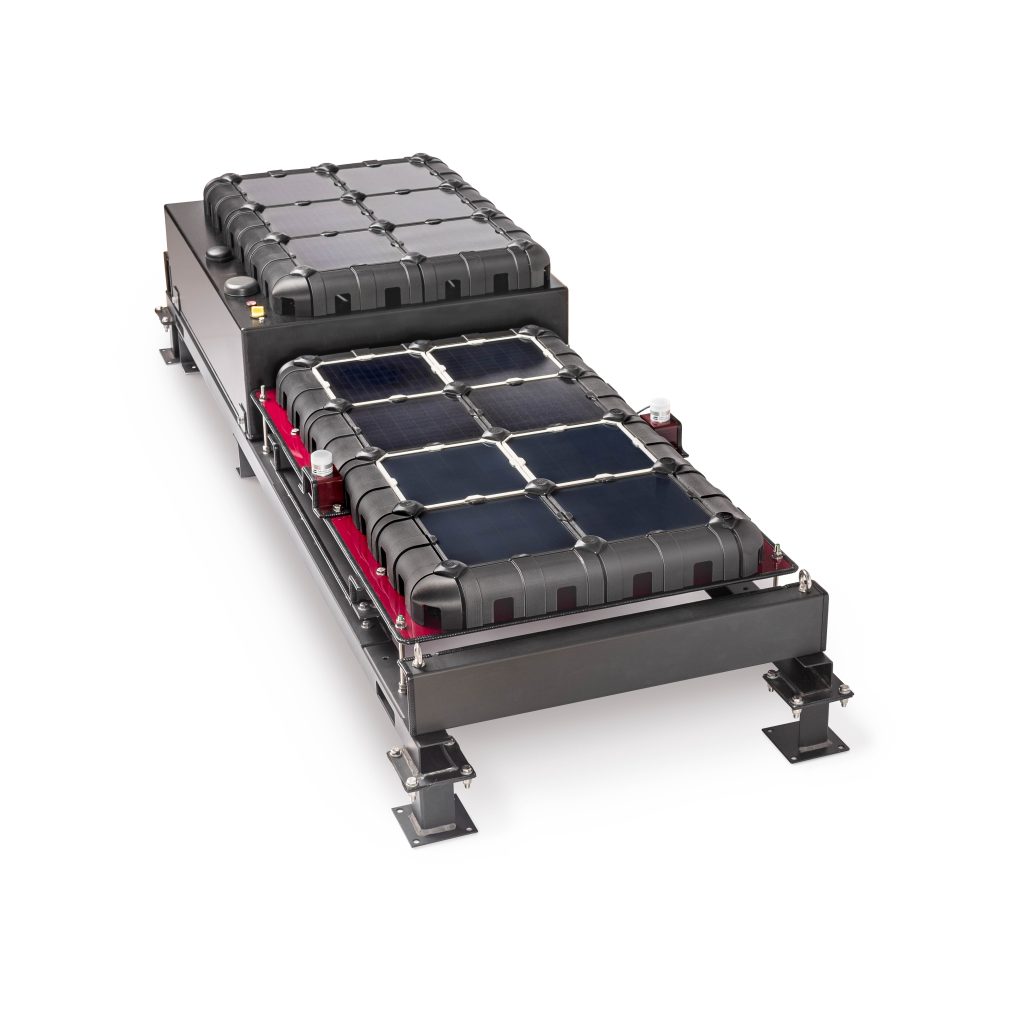
crafted exclusively to meet the operational and environmental challenges of maritime operations. Its NanoDeck system serves as a flexible, modular solar power solution designed to function in the harshest marine environments.
Made up of interconnected tiles composed of cutting-edge silicon and perovskite materials
Photovoltaic materials, the system transforms flat surfaces, such as ship decks, port
structures, or offshore platforms, into smart energy centers. The interconnected tiles integrate solar energy production with combined storage systems, ensuring quick and consistent power supply in different working conditions.
Built for durability in marine environments, the tiles are made from reinforced
materials that provide outstanding toughness, resistance to rust, and structural strength, and are attached and secured directly to a ship's deck.
The system's modular design makes it easy to upgrade existing fleets and smoothly incorporate into the construction of new ships. Importantly, each tile functions as a standalone power unit, which can be grouped together for increased capacity or replaced separately without affecting the overall system.
At its core, the scalable platform transforms and stores energy to deliver uninterrupted power of up to 600 volts, whether at sea, in port, or in off-grid locations. It helps cut operational expenses, enhances energy efficiency, and minimizes carbon footprints. Indeed, digital testing has demonstrated that it can save as much as 10% of fuel on an oil tanker—up to 10 tonnes of heavy fuel oil daily—with the possibility of reaching a 40% reduction over five years by expanding the system and advancing technology continuously.
A major benefit of the system is its ability to work with other decarbonization methods
pathways. It is intended to work in conjunction with current propulsion systems and new eco-friendly fuels, and can function with wind-powered assistance, serving as a flexible component of any environmental plan.
Green port infrastructure
Although ships receive the majority of focus in conversations about reducing carbon emissions, the emissions produced during port activities still represent a significant and frequently neglected source of greenhouse gases. Studies indicate that as much as 85% of emissions from tankers happen when they are berthed in ports.
As the demand increases to cut down on ship-related emissions, focus should be directed towards ports.
infrastructure as a domain where significant sustainability improvements can be realized. The incorporation of renewable energy systems, especially solar technologies, presents a practical option.
The compact, ready-to-use design of systems like NanoDeck enables for
installation in various settings, such as buildings, dock facilities, and specialized energy areas, to produce clean, localized electricity. This helps lower the carbon impact of port activities and allows vessels to turn off their engines when berthed, using power from the port's sustainable energy network.
Supported by AI
Artificial intelligence (AI) has become prevalent in every industry and sector, with shipping being no different. Grafmarine's AI-powered platform, NanoPredict, aims to enhance the way ships produce, store, and utilize renewable energy while at sea.
The system utilizes over twenty years of worldwide weather information in major shipping routes to predict environmental factors and modify energy consumption accordingly. This forecasting ability allows ships to regulate power usage in real time, ensuring that stored energy is utilized optimally throughout the journey.
Furthermore, integrating intelligent automation within onboard energy systems enables the transformation of shipboard energy management into a forward-thinking, data-driven approach. This not only aids in meeting changing emissions standards but also enhances cost forecasting and equipment efficiency.
Approximately 100,000 vessels are currently in operation, producing almost 940 million tons of greenhouse gases each year. Solar energy solutions offer a viable approach to achieving international climate goals and improving the reliability of operations in the maritime industry.
"Solar technology: powering the future of shipping" was first developed and released byShip Technology, a Tech Bytes Lab-owned brand.
The content on this website has been added in good faith for general informational use. It is not meant to serve as advice that you should depend on, and we make no representation, warranty, or guarantee, either express or implied, regarding its accuracy or thoroughness. You should seek professional or expert guidance before making, or deciding not to make, any action based on the information found on our site.
No comments:
Post a Comment