
 by
by 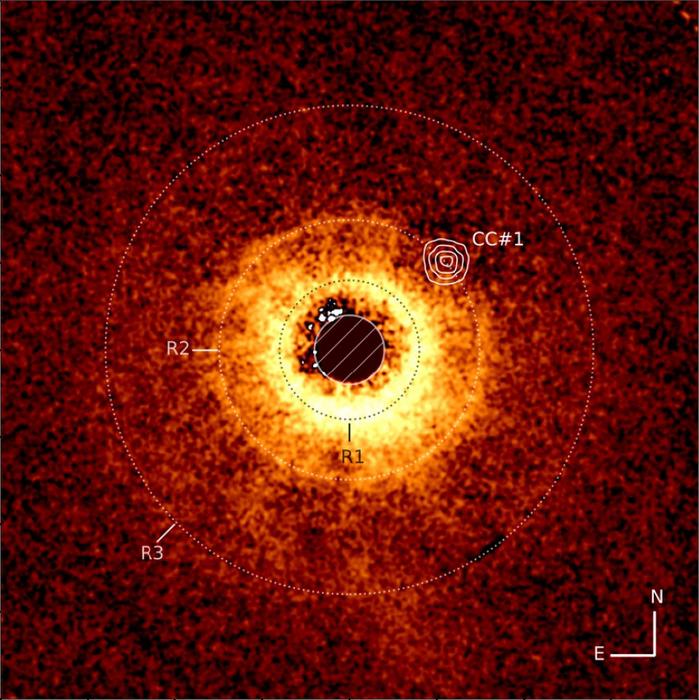
The James Webb Space Telescope has observed an exoplanet that had never been seen before. This represents a significant milestone in space exploration and paves the way for discovering small, icy worlds located far outside our solar system.Solar System.
The Quest for Secret Planets
Researchers have consistently searched for exoplanets to understand the formation of planetary systems. Exoplanets revolve around stars outside our solar system, and studying them offers insights into our astronomical history. Many of these planets have been discovered using indirect techniques. However, obtaining direct images is uncommon since exoplanets are faint and get obscured by the brightness of their host stars.
Researchers at the Observatoire de Paris-PSL, working with Université Grenoble AlpesThey utilized a new tool to address this issue. They connected a coronagraph to Webb's MIRI instrument. This coronagraph prevents the star's light from interfering, similar to how the Moon blocks the Sun during an eclipse. This allowed for the visibility of dim objects near bright stars.
Published in the journal, Nature, they discovered a new exoplanet situated within a ring of rocky debris and dust. This planet, called TWA 7 b, is the first one identified by Webb through direct imaging.
Rings and Hints in Celestial Particles
Most planets originate from dust and gas within rotating disks surrounding newly formed stars. As time passes, the gas dissipates, resulting in debris disks composed of rocky particles. These disks can persist for several million to several billion years. They frequently display rings, gaps, and empty regions that suggest the presence of hidden planets influencing their structure through gravitational forces.
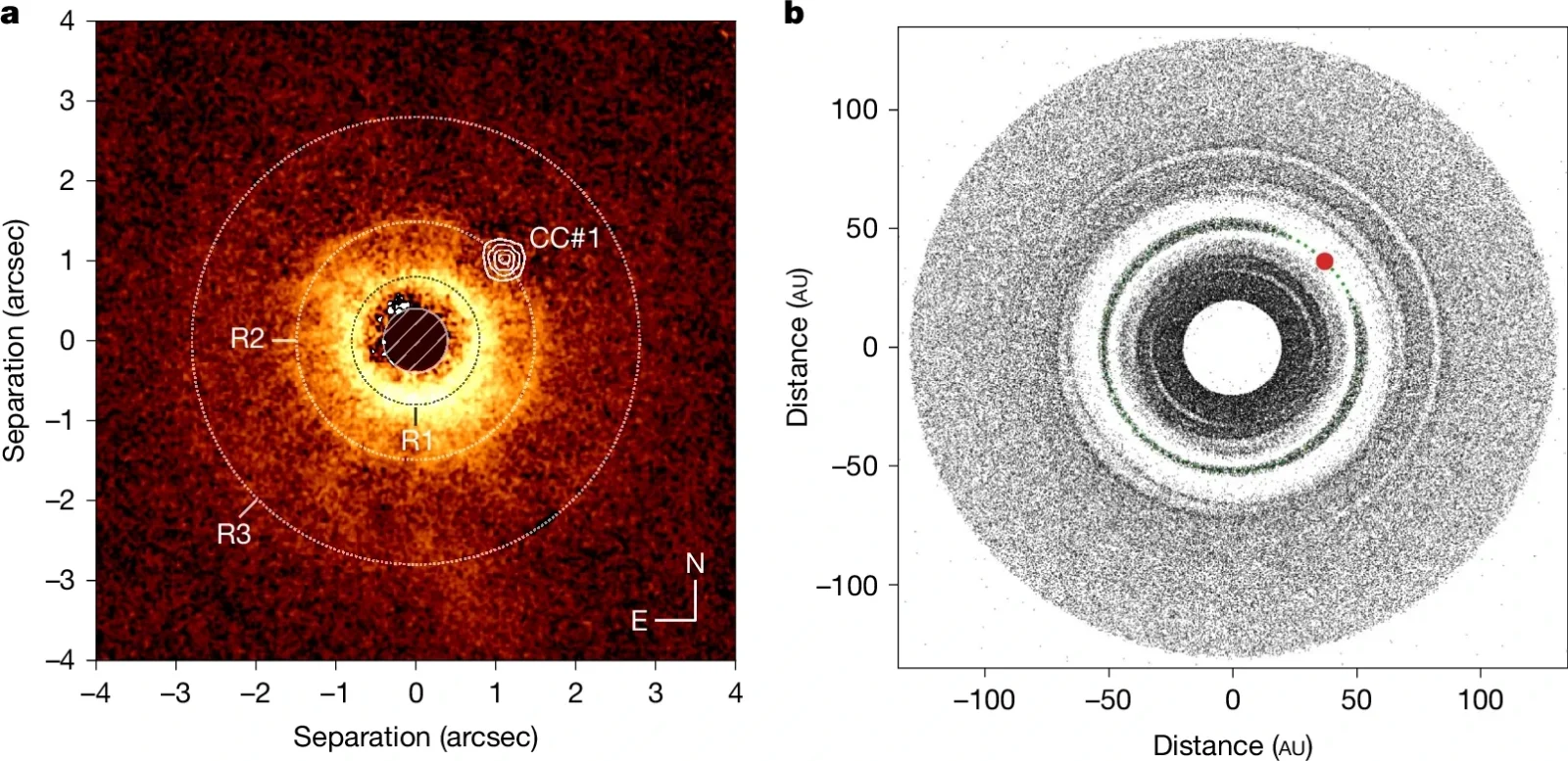
The star TWA 7, located approximately 34 parsecs away, possesses a disk. It is merely 6.4 million years old and is part of the TW Hydra association. Its disk exhibitsthree main rings, viewed from above. The innermost ring is located 28 astronomical units (AU) away from the star. A very thin ring is found at 52 AU, while a wide outer ring extends to 93 AU.
Researchers had long believed that unseen planets were responsible for these rings. However, prior to the James Webb Space Telescope, observational instruments could only detect planets that were two to ten times as massive as Jupiter. This limitation was overcome by Webb's advanced mid-infrared capabilities.
Related Stories
・Researchers discover that Earth-like exoplanets are prevalent throughout the cosmos
・Astronomers discover that an unexpected number of exoplanets may be capable of supporting life.
・Astronomers obtain the first three-dimensional perspective of an exoplanet's atmosphere and weather patterns.
A Breakthrough Image
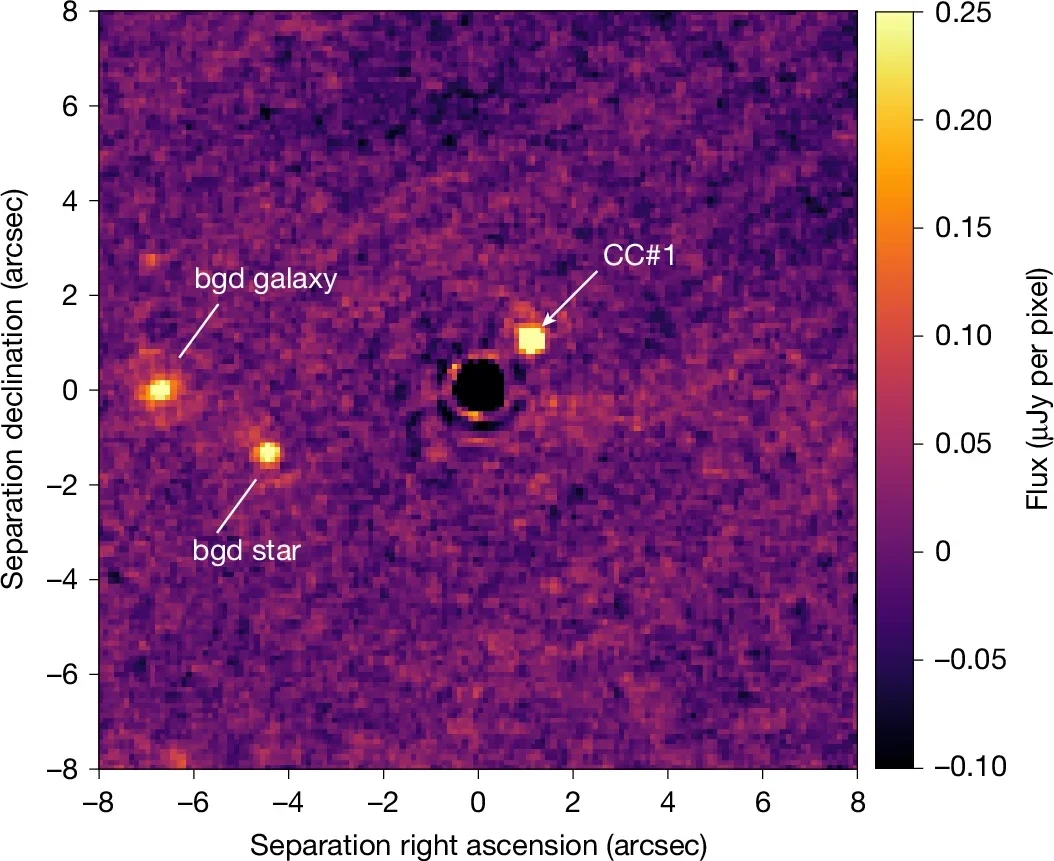
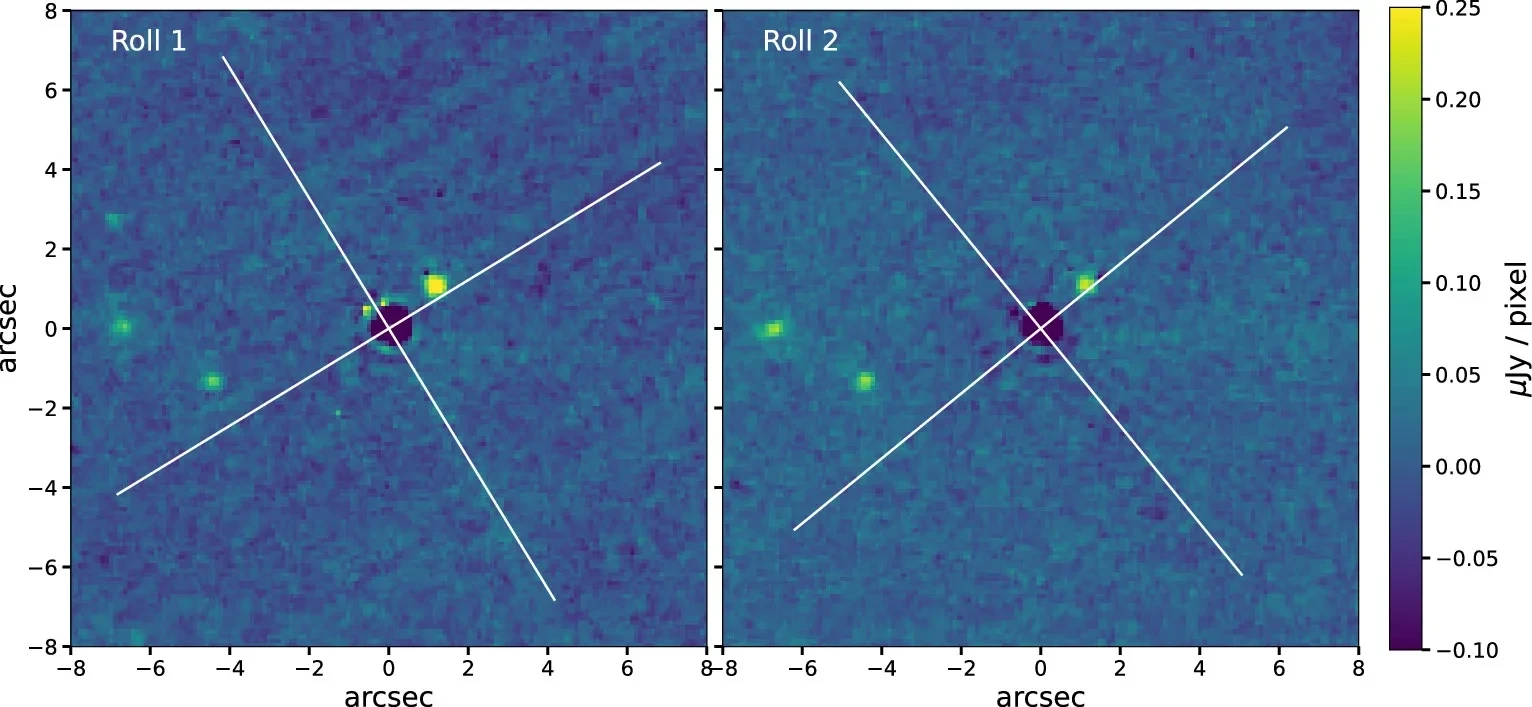
On June 21, 2024, the Webb telescope took coronagraphic images of TWA 7 using its F1140C filter, which is designed to observe light at a wavelength of 11.3 microns. The researchers contrasted these images with those of reference stars to eliminatelight distortionsThe last images showed three bright spots close to TWA 7.
One was a supporting actor already recognized. The second appeared like a faraway galaxy. However, the third object, approximately 1.5 arcseconds to the northwest of TWA 7, was distinct. Its position corresponded to the thin ring observed at 52 AU, and it had no prior record in earlier observations.
Scientists dismissed the possibility that it was an object within the Solar System. Even distant dwarf planets such as Sedna exhibit movement during two-hour exposures, but this object remained stationary. Its absence of motion indicated it was not a background star either.
They also examined whether it might be a remote galaxy. The likelihood of discovering such agalaxyAt that precise location, the percentage was only 0.34%. When combined with its placement inside the ring gap, this made the galaxy theory improbable.
Confirming a Planet
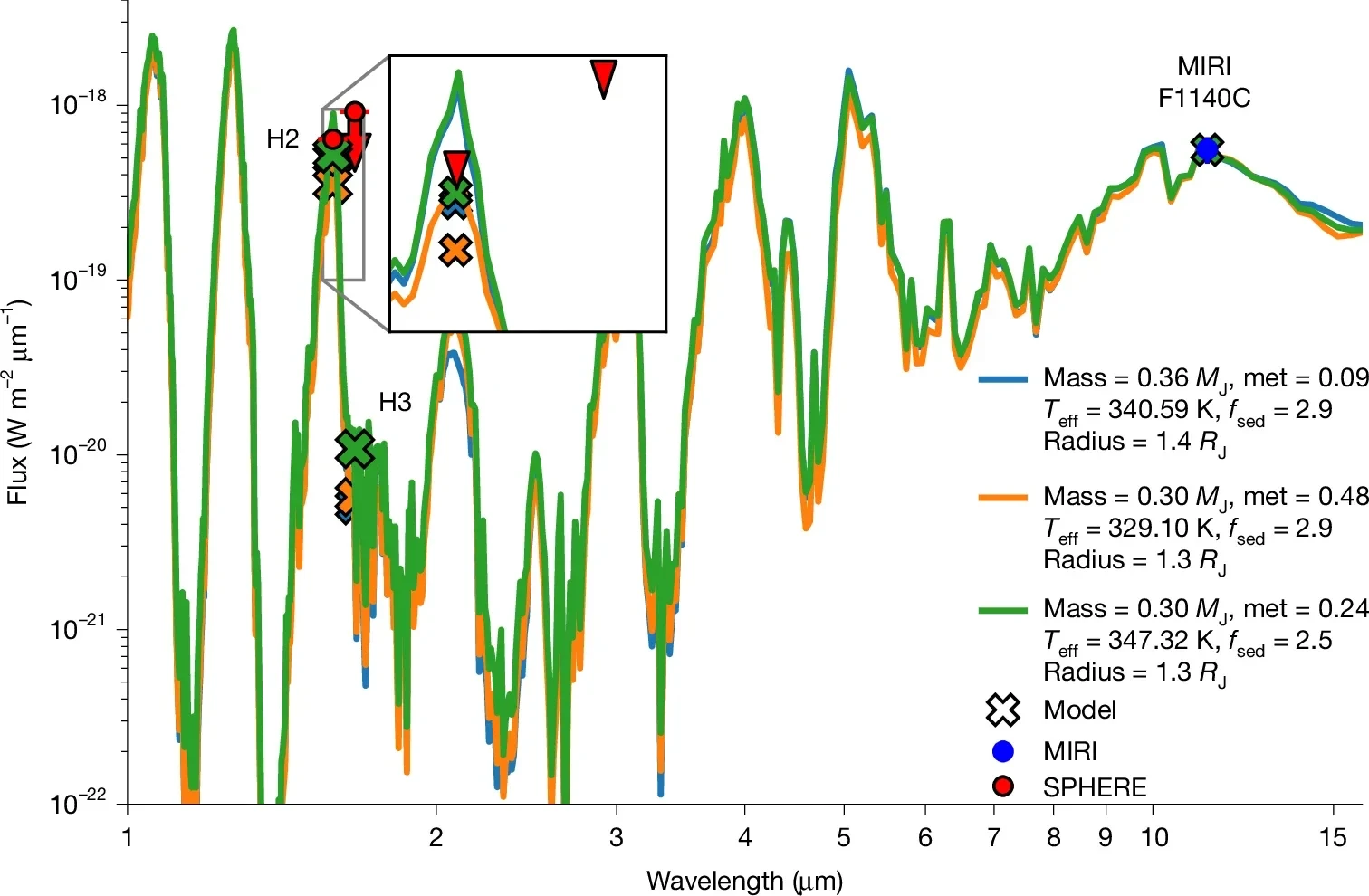
Using the HADES framework, which examinesplanetary atmospheresand evolution, researchers calculated the object's temperature to range from 305 to 335 Kelvin. Its mass was approximately 0.3 times that of Jupiter, comparable to Saturn. Simulations indicated that a planet of this size would form a narrow ring and a gap precisely where Webb observed them.
Further N-body simulations supported this finding. They modeled 200,000 rocky objects orbiting TWA 7 along with a planet having 0.34 times the mass of Jupiter. After six million years, the planet's gravitational influence created a thin ring at 52 AU and formed a gap in the region where the planet is located.
"The resemblance between the TWA 7 disk image and the simulation is impressive," the group stated. This alignment between theory and observation reinforced the argument that the object is truly TWA 7 b.
Looking Further into TWA 7 b
This finding is thrilling because TWA 7 b is ten times lighter than any exoplanet previously observed using direct imaging. It is not a giant likeJupiterbut a smaller, colder world.
Its relatively low temperature, approximately 320 Kelvin, makes it a suitable candidate for examining gas planets that are not exposed to significant radiation. In contrast to Jupiter, which reflects a considerable amount of sunlight, TWA 7 b primarily emits light due to its internal heat. Analyzing its atmosphere in comparison to Saturn or cold planets such as eps Ind Ab might provide insights into how these celestial bodies originate and develop.
Researchers think that Webb might discover smaller planets in the future. This could involve planets that have only 10% of Jupiter's mass.
How the Webb's Instruments Enabled This Achievement
The crucial element of this finding was Webb'smid-infrared instrumentand its French-manufactured coronagraph. By obstructing the star's light, the coronagraph enabled astronomers to detect subtle heat signatures from the planet.
Scientists collected four hours of data on TWA 7 and contrasted it with a comparable star to eliminate light interference. Subsequently, they applied computer simulations to verify the planet's temperature and mass.
The coronagraph's achievement highlights the significance of innovative instruments inastronomy. Without it, the faint light of TWA 7 b would have remained concealed forever.
A Fresh Era for Exoplanet Studies
This discovery confirms that theJames Webb Space Telescopecan identify significantly smaller exoplanets than previously possible. With advancements in technology, you may soon discover planets that are even more similar to Earth.
Next-generation telescopes will employ more advanced coronagraphs to look for planets outside our Solar System. Researchers have already identified potential targets for these missions.
According to the research group, this is only the start. The route to discovering additional small, icy planets is now available, and every finding moves us nearer to comprehending our origins.
Note: The article mentioned above was provided byThe Positive Aspect of News.
Like these types of uplifting stories? GetThe Positive Aspect of News' newsletter.
No comments:
Post a Comment