
 by
by 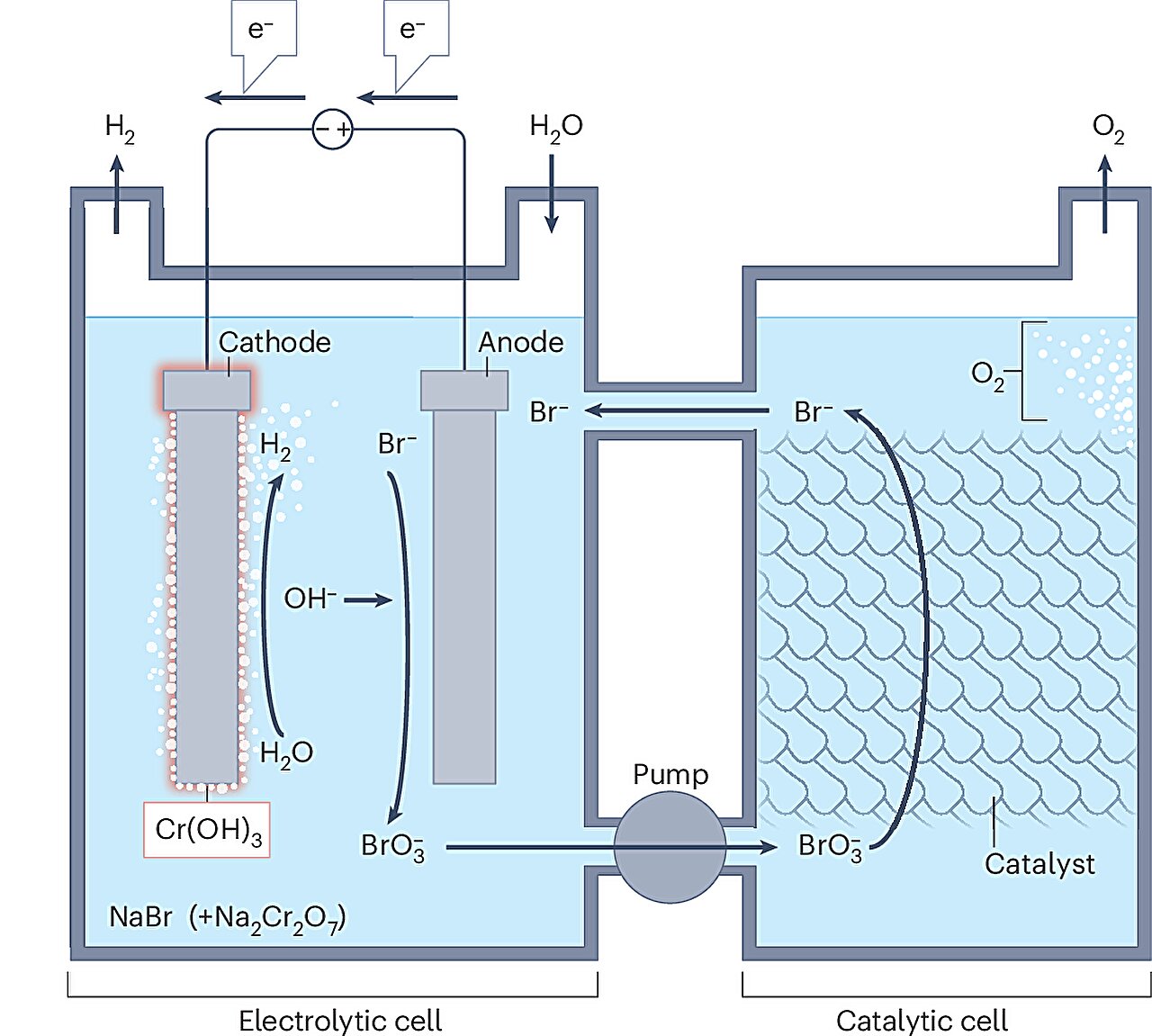
A recent review in Nature Reviews Clean Technologyintroduces, for the first time, a method to expand decoupled water electrolysis (DWE) technologies for generating large-scale green hydrogen.
Subscribe to our newsletterfor the most recent science and technology news updates.
Hydrogen, an essential component in chemical manufacturing, is typically derived from non-renewable sources, leading to significant carbon dioxide emissions. Electrolysis of water using renewable energy sources releases oxygen instead of carbon dioxide, providing a sustainable option. Large-scale production of green hydrogen is considered a major goal in the shift toward cleaner energy, as it could enable the replacement of global reliance on fossil fuels.
Standard electrolysis involves two electrodes divided by a membrane to separate water into hydrogen and oxygen. This method is costly, experiences internal hydrogen leakage, and does not work well with solar and wind energy that is not constant.
DWE addresses these challenges by dividing the production of hydrogen and oxygen either temporally or spatially, removing the necessity for membranes. Instead, it employs redox materials capable of absorbing and releasing ions, from which oxygen or hydrogen is generated.
The article examines various DWE techniques and, for the first time, outlines practical approaches for scaling up. The contributors are renowned specialists from around the globe: Prof. Avner Rothschild from the Technion's Faculty of Materials Science and Engineering, Prof. Mark D. Symes from the University of Glasgow, Prof. Jens Oluf Jensen from the Technical University of Denmark, Dr. Tom Smolinka from the Fraunhofer Institute for Solar Energy Systems ISE, Rotem Arad and Gilad Yogev from the company H2Pro, Technion postdoctoral researcher Dr. Guilin Ruan, and University of Glasgow doctoral candidate Fiona Todman.
In 2013, Prof. Mark Symes and his team at the University of Glasgow introduced the first version of decoupled electrolysis, employing redox mediators in a liquid solution. He has since kept working on decoupled electrolysis with different liquid-based systems and is currently making efforts to bring this technology to market via the company Clyde Hydrogen Systems.
In 2015, Professor Avner Rothschild introduced a novel technology alongside colleagues from Technion, including Professor Gideon Grader, Dr. Hen Dotan, and Dr. Avigail Landman, utilizing nickel-based redox electrodes. This innovation resulted in the establishment of H2Pro in 2019.
Prof. Jens Oluf Jensen and Dr. Tom Smolinka are globally recognized specialists in advanced electrolyzer technologies. Their research on proton exchange membranes (PEM), anion exchange membranes (AEM), electrode materials, and their use in cell stacks for high-capacity PEM and AEM electrolyzers has offered important understanding of the challenges involved in scaling up and operating commercial electrolyzers, as well as a solid foundation for comparing innovative decoupled and membrane-free electrolyzer concepts. Rotem Arad and Gilad Yogev offer perspectives on converting these ideas into scalable technologies for producing green hydrogen.
This critique presents the initial comprehensive analysis of practical methods for scaling up DWE. Although laboratory-scale DWE processes yield less than a gram of hydrogen per day, industrial applications need to produce approximately one ton each day—a millionfold increase.
Certainly, fulfilling today's hydrogen demand would necessitate approximately a million large-scale electrolyzers. In contrast, traditional industrial electrolyzers need a consistent power grid and can only be utilized to a limited degree with power variations that are highly dynamic, like those generated by solar and wind energy.
DWE's distinct benefit comes from its ability to store energy using redox materials, acting similarly to an electrolyzer that includes an integrated battery. This enables it to manage energy variations from renewable sources, making it very suitable for use with solar and wind systems, thus providing a key route for affordable, environmentally friendly renewable hydrogen generation.
The significance of expanding green hydrogen production is substantial. The hydrogen market is currently valued at approximately $250 billion each year. When it becomes accessible at an industrial level, the market for green hydrogen is projected to grow to $550 billion within a decade.
"Green hydrogen is anticipated to make up 10% of the future energy market. When it becomes feasible to generate green hydrogen on a large scale and offer it at competitive prices, hydrogen is expected to take the place of a significant portion of the energy utilized in industry, heavy transportation, and other areas," said Prof. Rothschild.
Conventional electrolyzers need to change to meet the demands of this market, as Darwin pointed out, it's not the strongest species that survives through evolution, but the one most capable of adapting and adjusting to its changing environment. I think DWE will be that.
"Decoupled electrolysis is merely around 12 years old. More traditional methods, like alkaline and proton-exchange membrane cells, have had many decades (or even centuries) to evolve. This provides some background on how quickly these new decoupled systems are beginning to scale," explained Prof. Symes.
Following the present course, I anticipate that within the next ten years, decoupled electrolysis systems will emerge as significant rivals to traditional electrolyzers, particularly for transforming renewable energy into green hydrogen.
The innovative concepts outlined in the review article are persuasive and provide insight into the future potential of expanding DWE technologies for the advantage of everyone.
More information:Guilin Ruan and others, Technologies and possibilities for independent and membrane-free water electrolysis,Nature Reviews Clean Technology (2025). DOI: 10.1038/s44359-025-00061-1
Provided by the Technion - Israel Institute of Technology
This narrative was first released onTech Xplore.
No comments:
Post a Comment