
 by
by Having a properly set up enclosure for your leopard gecko is crucial to both their health and overall happiness under your care. Creating a leopard gecko habitat can be confusing, especially for novice reptile keepers, due to the need for correct lighting, temperature, humidity, and decorations. If you’re struggling with how to set up your leopard gecko’s habitat, check out our guide to leopard gecko tank setup ideas here.
We’ll cover everything you need to know about perfecting your new reptile friend’s home. In addition, we’ve added five great tips to elevate your gecko’s tank setup from basic to something truly extraordinary!
The Basics
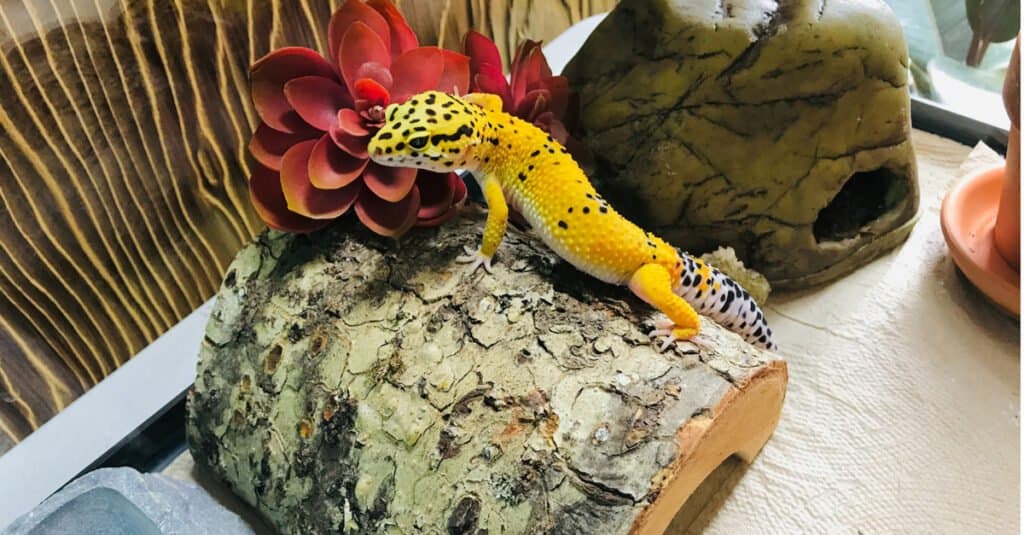
Before you begin working on elaborate setups, it’s best to first thoroughly understand the basic items your leopard gecko’s tank will need. Although leopard geckos are low-maintenance pets, they still have unique care requirements that must be met for them to truly thrive in captivity. If you do not already have the tank, the RSPCA recommends one that is 24 x 16 x 12 inches for a single gecko.
Your leopard gecko’s tank setup should imitate their natural habitat as closely as possible. The first thing to remember is that leopard geckos are native to Afghanistan, Pakistan, India, and Iran. Leopard geckos prefer dry, desert-like environments with lots of heat and light. Here are the main things you’ll need to supply your leopard gecko tank.
Heating
The enclosure needs a gentle gradient from the hot side (the basking area) to the cooler side. Under the basking area, temperatures should be around 90°F , while the cooler end should be around 77°F. Ensure the overnight temperature does not drop below 65°F .
Lighting
Enclosure lighting should mimic natural sunlight: 12 hours on, 12 hours off. This can easily be achieved with a simple white basking bulb, which will also provide heat to your gecko’s habitat. UVB is optional but can be beneficial.
Proper Humidity
Since leopard geckos are desert dwellers, they need low humidity settings in captivity, or around 30% to 40% at all times. Keep moisture to a minimum. Place your gecko’s water dish away from the basking bulb to prevent evaporation, which adds more moisture to the air.
Both Dry and Humid Hides
A hide is simply a small, covered shelter for your gecko to sleep in or find privacy if they’re feeling shy. The humid hide should be placed towards the middle of the enclosure, filled with damp substrate, and misted daily. The dry hide should be towards the cooler end of the enclosure and have a dry substrate.
Safe Substrate
Substrate makes up the floor of your gecko’s enclosure. Avoid “loose,” substrates, or those made up of small, indigestible particles. Sand on its own, gravel, and wood chips, for example, are unsafe substrates, as your gecko could accidentally ingest them and become impacted. A safe loose option is a mixture of 70% topsoil with no additives and 30% play sand. The safest options are tile, flat stones, reptile carpet, or even paper towels.
Food and Water Dishes
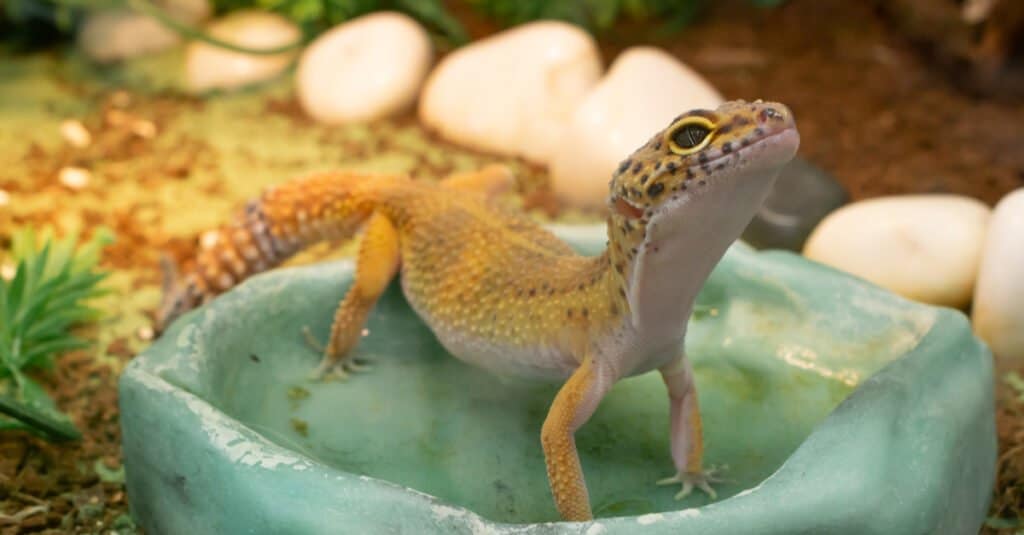
Your gecko needs shallow dishes made of ceramic, glass, or plastic. Keep these as clean as possible. Place the water dish towards the cooler end of the enclosure to prevent the water from evaporating and raising the tank’s humidity. Always keep substrate out of food and water dishes to keep your gecko from ingesting it.
Decorations
From plants to bridge signs and other fun decorations, your gecko’s tank will need some clutter to make your pet feel sheltered and safe.
Now that you have a better idea of the basics your scaly friend’s habitat needs, let’s get into some fun leopard gecko tank setup ideas. These tips will elevate your pet’s tank from basic to beautiful in just a few simple and inexpensive steps.
Experiment with Hides
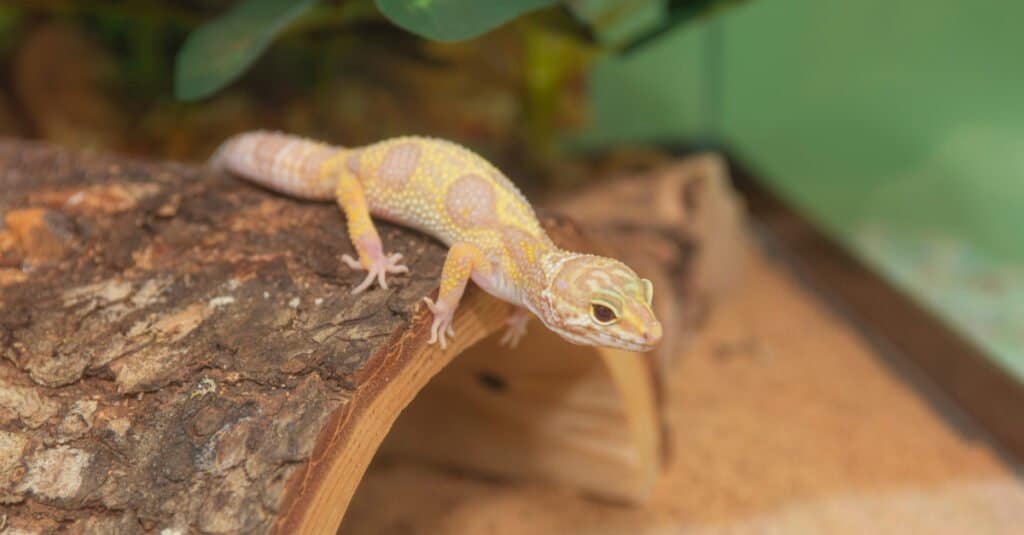
As we briefly covered above, your gecko’s enclosure needs two types of hides: a dry hide and a humid hide. Thankfully, you have a lot of room for experimentation here as far as size, shape, and style go. Both of your gecko’s hides should be small enough to be cozy, yet large enough to comfortably fit the lizard’s entire body. Aside from that, though, you can choose whatever hides look great to you or even make your own!
Some examples of hides on the market are hollowed-out coconuts, wooden logs, and stone caves. There are even hides with built-in humidifiers, which can be helpful if you prefer not to mist your gecko’s humid hide daily.
Plants, Plants, Plants
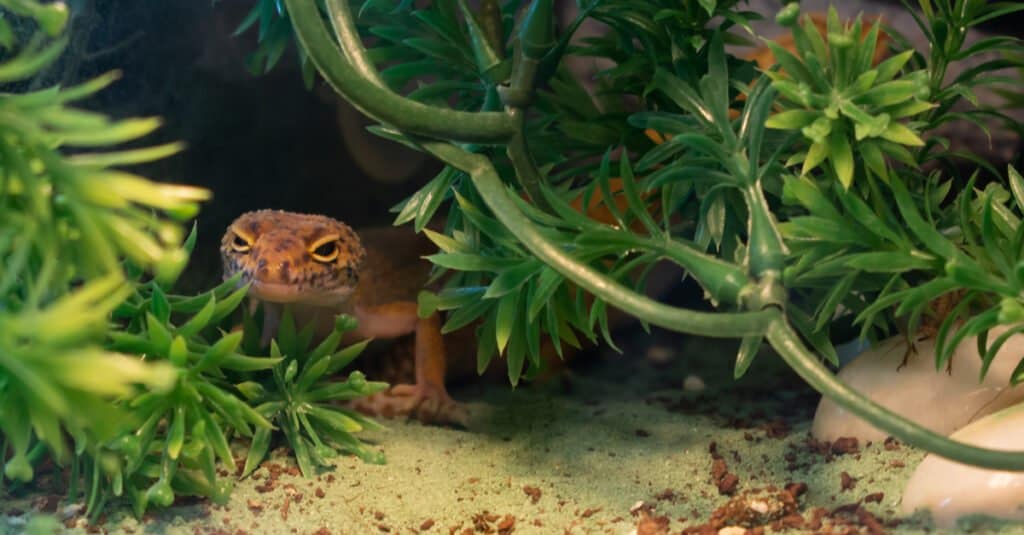
Leopard geckos are terrestrial and don’t climb much naturally. However, they do still benefit from a generous amount of plant cover in their enclosures in captivity. It doesn’t really matter if the plants are real or artificial. Be warned, however, that genuine plants can raise the humidity to unsafe levels.
Another good reason to use artificial plants instead of real ones is that they last longer and are easier to set up, care for, and move, especially for novice reptile owners. There is also no risk of your gecko eating them.
The best part is you can get pretty creative with them! Try using plants of different shapes and sizes, such as hanging vines and large, sturdy plants with lots of leaves. These types of plants give your gecko a bit more privacy. Plants also provide enrichment and encourage your gecko to explore and interact with their environment.
Customize the Background
Most basic enclosures have transparent glass or mesh walls, which can be a bit boring for you and your gecko to look at. Being able to see out of their enclosure can also make your gecko feel exposed or stressed, which is why plenty of decor and plant cover is beneficial for them.
There’s a lot you can do when it comes to customizing the background in your gecko’s enclosure. Many brands and online retailers even sell premade backgrounds of desert landscapes that mimic your gecko’s natural habitat. Simply unroll the sheet, cut it to size, and either glue or tape it to the back of the enclosure.
Experiment with Substrates
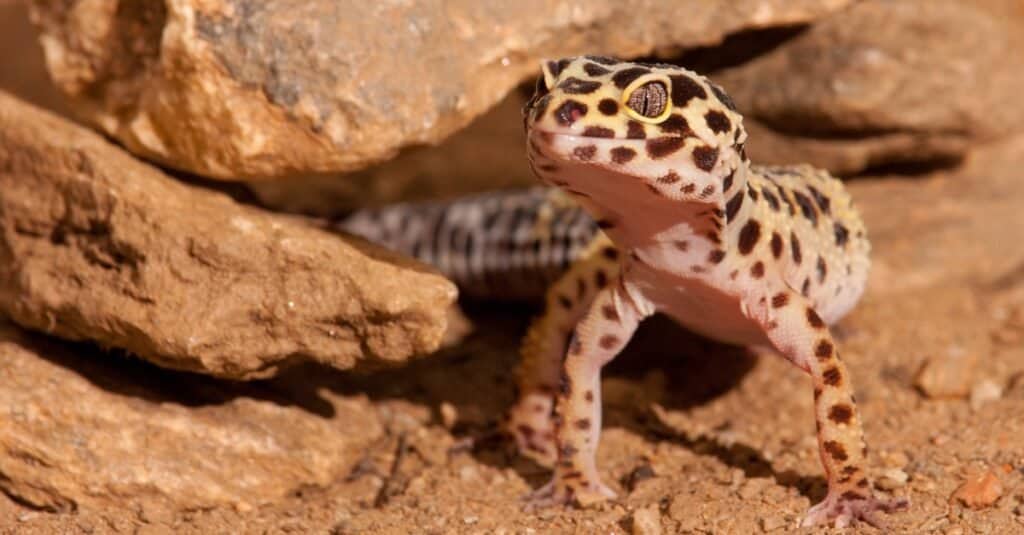
Substrates can also spruce up a reptile enclosure in a pinch, especially if you’re on a budget. Of course, using a safe substrate is crucial. Many loose substrates contain small, indigestible particles. These substrates, such as sand on its own, gravel, and wood chips, pose a risk of impaction.
Thankfully, there are just as many safe substrates that look great and feel great for your gecko to walk on, such as:
- Flat stones or tiles
- Stick-down linoleum
- Reptile carpet
- Reptile sand mats
- Bioactive substrates (not recommended for novice reptile keepers)
Try experimenting with these different substrates to find what looks best to you. Sand mats are especially natural-looking, and they are much safer than actual sand, since the sand particles and pebbles are secured safely to the mat.
Experiment with Elevation Variation
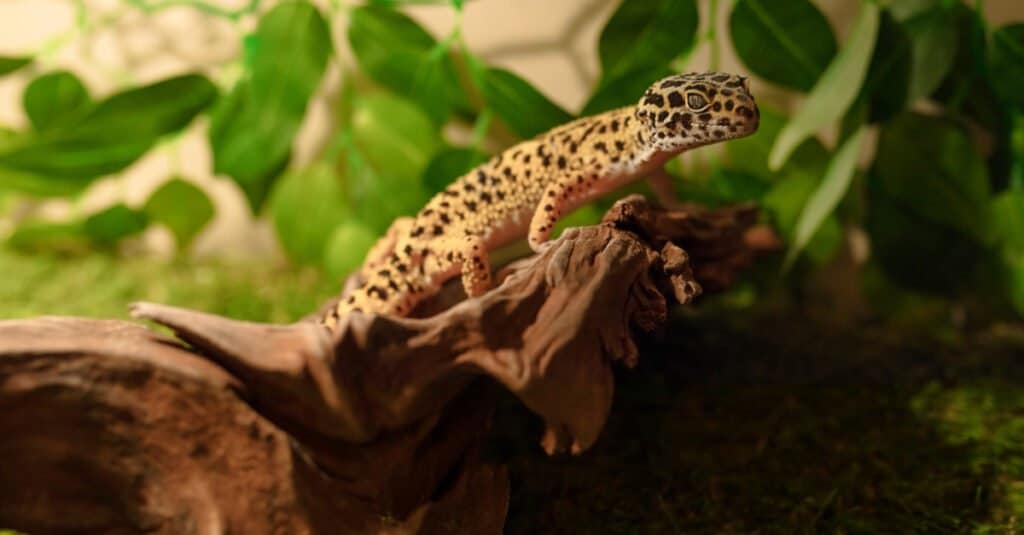
If your leopard gecko’s enclosure doesn’t have much elevation to speak of, why not give it a bit more dimension? Although leopard geckos don’t climb as much as most other lizards , they do appreciate enclosures that aren’t completely flat. We love this idea for leopard gecko tank setups because there’s so much room for customization.
Remember, you ideally want to mimic your pet’s natural habitat as closely as possible, within reason, of course. In the wild, leopard geckos live in hilly, sandy deserts and scrublands, which have lots of variation in their elevation and terrain. Try stacking flat stones, adding bridges, hammocks, other platforms, or even small inclines throughout the enclosure.
Not only will your gecko’s enclosure look better as a result, but your gecko will also enjoy the extra enrichment of exploring a more interesting-looking, authentic habitat.
Follow A-Z Animals!
- See today’s latest and most exciting animal news when you follow A-Z Animals. Click here to access the A-Z Animals profile page and be sure to hit the Follow button here or at the top of this article!
- Have feedback? Add a comment below!
The post Leopard Gecko Tank Setup Ideas appeared first on A-Z Animals .
No comments:
Post a Comment